

Funding Your Child’s Future
Saving & Investing for Your Child's Future
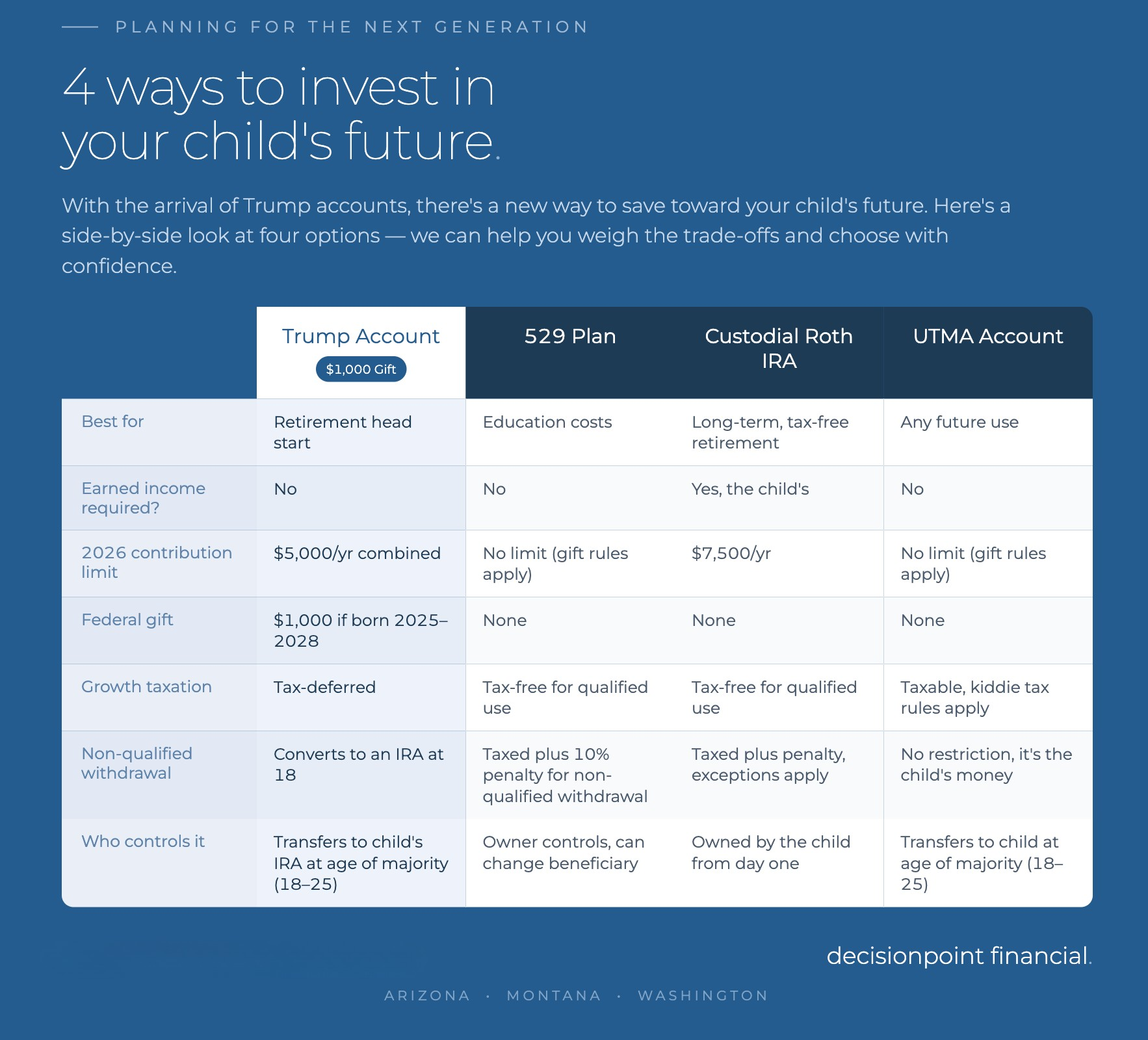
Parents and grandparents now have more account options than ever to help children prepare financially for their future. Two are designed specifically to save for a child's retirement, one is built for education, and one offers maximum flexibility for building wealth — for a future home, a first car, or anything else. Each comes with its own rules and tax considerations. Here's a breakdown of the accounts you can open for a minor child, and how to use each one effectively.
1. Trump Accounts (TAs)
Trump Accounts are a new type of retirement savings account created by federal law to encourage long-term investing for children. Unlike Traditional or Roth IRAs, contributions do not require the child to have earned income, allowing families to begin investing from birth. Starting at birth provides one of the longest possible investment horizons — decades of potential tax- deferred compounding.
$1,000 GIFT - The headline. Children born between January 1, 2025 and December 31, 2028 receive a one-time $1,000 federal contribution when an account is opened at trumpaccounts.gov.
WHO CAN HAVE ONE
- The beneficiary must be a U.S. citizen with a valid Social Security number.
- The beneficiary must be under age 18.
- Only a parent or legal guardian can open the account.
CONTRIBUTIONS
- Parents, other family members, non-family members, and employers can contribute up to a combined $5,000 per year, on an after-tax basis.
- Annual contributions must be deposited by December 31.
- TA contributions do not reduce or count against a child's own IRA or Roth IRA contribution limits.
- Contributions are considered "present interest" gifts, so they qualify for the annual gift tax exclusion ($19,000 for 2026). As long as the donor is an individual, the contribution is made in cash, and total gifts to the beneficiary stay under that limit, no gift tax return is required.
INVESTMENTS
- Funds must be invested in eligible mutual funds or ETFs that track the S&P 500 or a similar broad U.S. index.
- Management and fund expense fees are capped at 0.10%.
TAXES
- On the way in: contributions are made with after-tax dollars and treated as gifts for gift-tax purposes.
- While it grows: investment gains inside a TA grow tax-deferred.
WHAT HAPPENS WHEN THE CHILD TURNS 18
- The account must convert to a Traditional IRA.
- Investment gains continue growing tax-deferred.
- Standard IRA withdrawal rules begin — generally income tax plus a 10% early withdrawal penalty before age 59½.
- The now-adult beneficiary may choose to convert some or all of the account to a Roth IRA.
- Taxes may be due on the gains that are converted. After-tax contributions (basis) aren't taxed again, but growth is taxed at the beneficiary's rate at conversion, and "kiddie tax" rules may apply.
THE BOTTOM LINE
If there's a child in your life born between January 1, 2025 and December 31, 2028, there's no reason not to open a TA and claim the free $1,000 — compounded at 9.0% for 60 years, that alone could be worth over $176,000 in future retirement dollars. For children outside that window, a TA is still a powerful way to start early and let compounding do the work.
2. 529 Education Savings Accounts
529 accounts are tax-free investment accounts designed to pay for a child's future education— K–12, college, graduate school, trade school, and continuing education. All 50 states and the District of Columbia sponsor a 529 plan, but you aren't required to use your own state's plan, and it pays to shop around. We recommend the Utah 529 plan, my529.org, to our clients for its low fees and highly rated investment options.
CONTRIBUTIONS
- Anyone can contribute, using after-tax dollars.
- Some states, including Arizona, offer a state income tax deduction for contributions.
- There's no annual contribution limit, but the annual gift tax exclusion ($19,000 for 2026) applies. The IRS allows up to 5 years of the exclusion ($95,000) to be contributed in a single year, though the donor can't make further contributions to that beneficiary for 5 years afterward.
INVESTMENTS
- Most 529 plans offer a wide array of options, typically age-based or risk-based portfolios.
TAXES
- Money grows tax-free and comes out tax-free as long as it's used for qualified education expenses. Non-qualified withdrawals are taxed on the gains at the owner's income tax rate, plus a 10% penalty (waived if the beneficiary earns a scholarship or qualifies for the GI Bill).
FLEXIBILITY
- The account owner — typically a parent, grandparent, or guardian — can change the beneficiary at any time, which also makes 529s a useful estate planning tool for tax-efficiently passing wealth to children, grandchildren, and future generations with an eye toward education.
THE BOTTOM LINE
If the goal is a child's future education, a 529 is the most tax-efficient vehicle available — with plenty of flexibility thanks to the broad definition of qualified expenses and the ability to change beneficiaries
3. Custodial Roth IRA
We strongly encourage clients to open a custodial Roth IRA for a child the moment that child starts earning W-2 or 1099 income. Getting money into a tax-free retirement account early in life means large tax-free balances after age 59½. For small-business-owner clients, we encourage finding ways to put your children on payroll so they meet the earned income requirement for Roth funding.
CONTRIBUTIONS
- Anyone with a valid Social Security number and earned income can open and fund a custodial Roth IRA, at any age.
- The 2026 contribution limit is $7,500 for those under age 50.
- A Roth IRA can be opened at any custodian and invested in any publicly traded security.
WITHDRAWAL RULES
To withdraw money completely tax-and penalty-free, two requirements must be met:
- Age — 59½ or older.
- 5-year rule — five years must have passed since January 1 of the tax year of the first contribution.
EXCEPTIONS
- First-time homebuyer: up to $10,000 of earnings can be withdrawn penalty-free for a first home purchase (the 5-year rule still applies to keep it tax-free).
- Disability or death: earnings can be accessed penalty-free.
- No RMDs: unlike a Traditional IRA, there are never Required Minimum Distributions during the owner's lifetime.
THE BOTTOM LINE
Encourage children and grandchildren to open and fund a Roth IRA as soon as they land their first after-school or summer job. The earlier money goes in, the more tax-free money there is for retirement.
4. UTMA Accounts
A Uniform Transfers to Minors Act (UTMA) account is a custodial brokerage account established for a minor child, offering maximum flexibility for future use of the assets — with a few important considerations.
CONTRIBUTIONS
- A parent or legal guardian can open the account in the child's name at any financial institution.
- There's no annual funding limit, but gift tax exclusion rules apply: contributions up to $19,000 per year per individual ($38,000 for married couples) are free from federal gift tax reporting in 2026.
- Contributions are an irrevocable gift — once made, the money legally belongs to the child.
TAXES
Investment income is taxed on a tiered schedule:
| $0 to $1,350 | Tax-free, covered by the child's standard deduction. |
| $1,351 to $2,700 | Taxed at the child's rate (usually 10%). |
| Above $2,700 | Subject to the "kiddie tax", taxed at the parents' marginal rate. |
Investment gains are also subject to capital gains taxes.
AT THE AGE OF MAJORITY
- At 18 to 25, depending on the state, the account must transfer into the child's own name, and they gain full control of the money.
THE BOTTOM LINE
A UTMA offers maximum flexibility if the goal is giving a child financial resources as an adult — but there are no protections against poor financial decisions. Using one requires trusting that the child will use the money wisely.
Frequently Asked Questions
Which account should I choose?
It depends on the goal. A retirement head start with no earned income requirement → a Trump Account. Education costs → a 529. Best long-term tax treatment once a child has a job → a custodial Roth IRA. Maximum flexibility for any future use → a UTMA. Many families use a combination.
Can I fund more than one type of account for the same child?
Yes. These accounts serve different purposes and can be funded simultaneously, subject to each account's own contribution rules and the overall annual gift tax exclusion across everything given to that child.
Do contributions affect my own retirement savings or gift tax situation?
Each account has its own contribution and gift tax treatment, described above. It's worth reviewing your overall annual gifting across all accounts and recipients to make sure you're staying within exclusion limits.
As always, please reach out if we can be of assistance.
- Your DecisionPoint Financial Planning Team -